A Torturous Trap: Water Shutoffs and Tax Foreclosure

Originally published in Riverwise Magazine
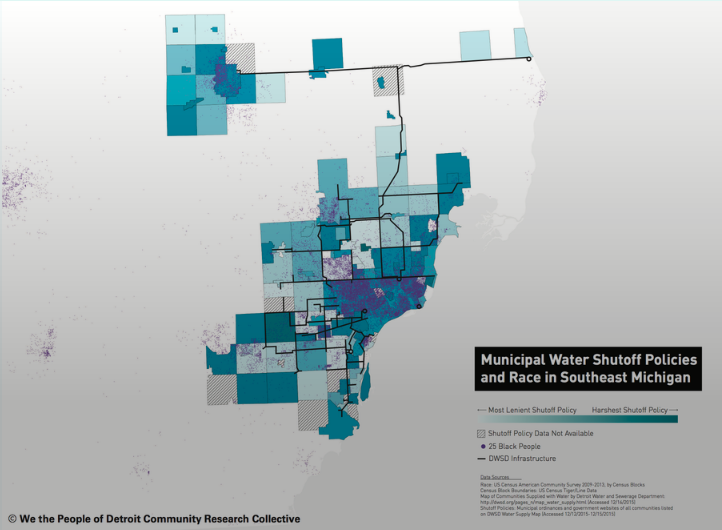
The dual issues of water shut-offs and tax foreclosure are well-known causes of individual and collective harm. In both cases, bills are inflated beyond reasonable or affordable levels. In both cases, those high bills can lead to people living without the basic human rights of water and shelter. In both cases, the result is often “passive eviction,” wherein people move out not because they were overtly forced out, but because their home is no longer habitable. Even the numbers are similar: as of this spring, another 17,000 Detroit families face water shut-off and that same number of occupied homes are at risk of tax foreclosure.

It is fairly common knowledge that an unpaid water bill can become a lien on a home that can contribute to tax foreclosure and the loss of ownership. What’s not as commonly known is that tax foreclosure often contributes to water shut-offs. A recent policy by Detroit Water and Sewerage Department (DWSD) is making it impossible for residents of tax-foreclosed homes to get water on, or forcing them to take on debts that were never their responsibility.


For years, DWSD has been moving away from “Resident” bills to bills in a person’s name. Resident bills are issued to whoever lives in the home, but are ultimately the responsibility of the owner, whereas a bill in a person’s name is personal debt that DWSD can pursue against that individual even if they leave the address. DWSD uses water shut-offs as an opportunity to require a resident to put the account in their name, which often means assuming any existing debt on the account as their responsibility.  To shift from a Resident account to an individual account, a person must show their lease or a deed, proving that they have a right to live in that home. For foreclosed properties, the Wayne County Treasurer is technically the owner from April 1 through the end of the year, when it transfers title to auction buyers (November in most cases). In the meantime, residents don’t have the paperwork they need to satisfy DWSD’s policy.


The policy is unnecessary because a person assumes responsibility when they put the account in their name. It’s burdensome because it is not legally necessary to have a written lease or deed to occupy a property. It’s harmful because there are literally thousands of homes owned by the government, for which there are no leases or deeds. The upshot is that if you happen to live in one of the 17,000 occupied homes in tax foreclosure or you happen to be in one of the 17,000 homes facing water shut-off, you may have no legal means of getting your water back on for many months.


There is much to hate about tax foreclosure, but for all its harms, the silver lining is that it clears away liens like taxes and water bills. The truth is that water bills are subject to be waived by tax foreclosure, so why are thousands of tax-foreclosed homes having their water shut off? DWSD doesn’t adjust the water bill for a foreclosed property when it is foreclosed April 1.  Rather, it waits until Wayne County Treasurer deeds over the property to a new owner. That’s often too late for the people suffering in those homes under a dry tap.


Under this process, the person who reaps the benefit of that write-off will be the new owner, not the person who lives there. Residents face a terrible catch: you can’t get water until you own the property, and you can’t own it unless you run the gauntlet of the auction and survive for months without water.


The problem is not limited to tax foreclosure.  Many thousands of occupied homes are owned by the Detroit Land Bank Authority (DBLA). DLBA eventually addressed this problem by issuing special letters to residents in their “buy back” program, to allow them to have water access while they are in the process of buying back their homes. Unfortunately, this is limited to a few hundred people in the program, not to the many thousands who live in DLBA houses or those who have already been driven out due to lack of water.


In response to pressure from advocates, DWSD has agreed to accept letters produced by the Wayne County Treasurer, similar to those issued by DLBA, in lieu of a lease or deed. Wayne County Treasurer writes these upon request by advocates, and, presumably, residents can take these letters to DWSD and create an account in their name. Under this policy, residents in tax-foreclosed homes should be able to get water on in their name with a clean slate. (If a bill is already in a person’s name, it will remain their responsibility.)


The letter is absurd as a solution given that DWSD has full knowledge of which properties are in tax foreclosure or are owned by the DLBA.  This information is public data. The letter “solution” creates yet another series of hurdles to jump through for those who have already suffered immeasurably through the combined traumas of housing and water instability.  Most residents who need it have no idea that such a letter even exists.


Even for those individuals who have this letter, the fight is far from over. As recently as May of 2018, a resident of a foreclosed home with a water letter from WCT was told her only option to avoid water shutoff was to assume the debt of the former owner. She agreed to pay $280 per month in addition to her monthly usage because she was under duress and had no other means of avoiding the shut-off for her and her grandchild. For this to happen even under the persistent watch of advocates essentially means that hers is a best-case scenario.


The solution? A moratorium on shutoffs for tax-foreclosed properties and/or an automatic waiver of ongoing water charges at the time of the foreclosure, not at the time of the sale.


In 2014, Detroit shocked the nation with 33,000 water shutoffs and nearly 24,000 tax foreclosures.  Public awareness of these issues and public outcry against them have died down, but these violations continue, and are no less inhumane now than they were then.


What Detroit lacks in traditional forms of wealth, it makes up for in vast resources of land and freshwater. Yet the resources we have in greatest abundance are the same ones that our government has taken as collateral for a fraudulently derived debt.  DWSD needs to wake up to the reality of the many thousands of Detroit homes that don’t fit into the convenient box of “owner” or “renter,” and provide a way to allow residents of government-owned homes to have access to water. They should regularly update records of government-owned and tax-foreclosed properties, they should allow water access to those willing to pay, and they should facilitate the transition of those properties into private ownership.  In the meantime, irreversible water shutoffs continue to plague thousands of families in post-bankruptcy Detroit.

Check-Save-Buy

Previously published in the Free Press with minor unapproved edits. Original below:

It started with a Facebook post “77-year old women needs help immediately!” The woman was a renter of a tax foreclosed home, and a stream of well-meaning friends offered their advice about what she should do. There was fear that she would face eviction, rumors about who owned it, and a lot of other well-intentioned misinformation. I was sad that, even after a decade where one in four properties in Detroit have gone through tax foreclosure, there is still a serious lack of information about what to do when your landlord doesn’t pay the taxes and the government becomes the owner of your home.

If you happen to live in any of the 15,000 occupied homes across Detroit that face tax foreclosure by the Wayne County Treasurer this year, you might have some questions about where your property stands and what to do next. I finally joined the conversation to try to clarify some of the confusion, and I will try to do so here in my capacity as a housing counselor.
So, if you’re a renter in a home that was foreclosed by the Wayne County Treasurer, here are your stop-drop-and-roll techniques for what to do when the government becomes the owner of your home: CHECK, SAVE, & BUY. Continue reading

Beneath The Steam

Originally published in Hour Detroit

An iconic image of winter in Detroit is the columns of smoke spewing from sidewalks. Steaming streets are part of the landscape, but few know the answers that lie beneath this mystery in plain sight.

Below our sidewalks, there’s a vast infrastructure that includes electricity, water, sewer, and fiber optics. In a portion of the city, there’s also a network for what’s known as superheated “district steam.”

Most buildings and homes have their own furnace or boiler, but properties on the district steam system connect to a grid that delivers steam directly to their pipes. It’s not so different from the way that most buildings receive electricity from a utility grid rather than having their own internal generator.

District steam is common in dense urban areas with large buildings because a central plant can be more efficient than individual boilers. The current system serves more than 100 buildings in greater downtown, including the GM Renaissance Center, Cobo Hall, the Fox Theater, and Ford Field.

But this type of system is limited for a reason: Heat escapes rapidly as the steam pipes pass by cold external air, so it is not suited for long distances.

Detroit’s system is notable because it is so extensive — with over 50 miles of steam mains — and because it is so old. The system dates to 1903, when it was opened by Detroit Edison Electric Company. It’s also very leaky, as evidenced by all the steam seen rising from city sidewalks and streets.

The leaks are more than a systemic inefficiency. They also bring their own quirky hazards. The thick columns of steam can create blind spots that are dangerous to both drivers and pedestrians. And apparently, enough passers-by have burned themselves on scalding steam, that one local law firm has a dedicated website for personal injury suits from “Detroit manhole cover steam burns.”

Minor perils aside, the steam itself is not all that scary. It is just hot water — not swampy sewer gas or exhaust from the forgotten Detroit salt mines.

One Man’s Trash … Continue reading

Government Can Stop Government Foreclosure

Originally published in the Detroit Free Press

If you’re anything like me, you feel a little sick when you hear that yet another 36,000 Detroit properties are facing tax foreclosure this year. Tax foreclosure is an autoimmune disorder through which our own local government has become the agent of its own destruction. The city, the county and the state all have a role in carrying out tax foreclosure, but they also have the ability to end it.

Prevent the Loss

The first priority must be to preserve homeownership. The most obvious solution for retaining homeowners is to use the federal funds already allocated for foreclosure prevention to actually prevent foreclosure, at no cost to local government.

Each year, the Michigan State Develop Housing Authority, (MSHDA) “Step Forward” program denies assistance to hundreds of applicants who ultimately lose their homes to tax foreclosure. Meanwhile, the funds go unused. MSDHA requirements are too judgmental, stringent and unreasonable for worthy homeowners to qualify, and the application period is too short. Local government should and could aggressively lobby MSDHA to better utilize its foreclosure prevention money for Detroit homeowners, and to increase this funding by returning demolition funds for their original purpose.

Another solution involves the expansion of the so-called “poverty exemption,” which waives taxes for Michigan homeowners with low incomes. This exemption could be extended on a retroactive basis (as with income taxes and the “principal residence exemption”).  A retroactive poverty exemption could annul the foreclosures for hundreds or thousands of at-risk Detroit homeowners who are losing their houses for taxes that they could have had waived.

At-risk homeowners need better payment plans. State law limits Wayne County’s options for reducing interest and debt, and over-assessed delinquent tax bills increase at 18% interest each year. One option is the so-called “SEVSPA” plan, a plan that cut tax debt to half the State Equalized Value. This existed under 2015 law passed with the support of Mayor Duggan, but it was only available temporarily at a time when property assessments across Detroit were still chronically over-inflated. We need more common-sense payment plans that reduce debt to some value proportionate to the home’s property value or the owner’s ability to pay. Continue reading

Deity Viety- Revelation

I’m quite sure that I had never truly prayed before. I know some who did, and swore by it. But most people I know do not pray, and I have never seen a need for it, or felt a calling to it. It was not until I watched with my own eyes as the tree line instantaneously receded from the nearby mountainside like a children’s flip book of the falling of winter changing leaves from green to auburn to a brittle desiccated brown, reducing the work of a month into a few moment’s time, that my mortality shivered in my heart and my mouth dropped open.

“My god” I said.

That was my first prayer.

Continue reading

Deity Viety- Creation

In the time before life, Earth was but a swirling mass of gasses: no land, no sea, no sky. A day was nothing but a shy twirl of the earth before the gaze of the sun, whose only impact was to stir the winds with waves of temperature that whipped the elements about. As they heated, cooled, mixed, and clashed, the stirring gasses combined into configurations of molecules, gaining weight, gaining complexity, gaining volume, gaining density. With time, the gasses transformed to liquid and created a great ocean. And with more time, there were humble solid specs floating in that ocean.

The solids were contained environments that allowed certain elements to remain locked together. Occasionally, two solids would collide, which sometimes resulted in larger configurations and new types of combinations. Other times a solid fractured its big pieces into small.

On one nameless morning amidst the coastless sea, the dawn light pierced a wave like a prism and cast down a laserlight concentration of energy onto a single solid speck in such a way that provoked a great reaction. The speck, now infused, could not contain its new energy and was forced to cleave apart. But this was different than the collisions that splintered solids into pieces, this reaction caused the physical to separate from the aphysical. No sound or light was emitted, but the energy converted into to forms- electricity known as Life, and an invisible magnetic charge known as God. Thus, the speck was infused with Life-state, and the space around it was filled with an equal-and-opposite God-state, a complementary, corresponding otherness. In this instant, the duel phenomena of Life and God came about. Continue reading

Deity Viety- Introduction

Here is a truth: you do not know what God is. You use this word, it’s a useful word, you are free to use it, and you will be almost right when you do. But you do not truly know what it refers to. That which you conjure when you point your word at it is at the same time smaller than what you think it is and also greater. It is smaller because it is not immortal, nor inevitable, nor universal. It is fragile and finite and formless. It is greater because it is dynamic, evolving, and intimate. It does not know you but it is of you.

I am. Life is. God is. I am alive. Lives are God.

Allow me to explain. Continue reading

Hamtramck Love Letter

Reflections on my journey to stay in one place

I never imagined I would be washing his dishes: the remains of some crusty casserole, six or eight months old; a mystery Tupperware; a rimmed teacup. I’m sure that if he had could have known that I, a woman he met only once, would be cleaning up after him, he may have taken care of the mess himself. Or maybe not. Maybe a century-old man only needs one plate and one cup, and maybe he relishes in leaving the rest of them dirty. Maybe he feels he’s cleaned enough dishes in his life and gets a kick out of the idea of some family member, some hired worker, some stranger doing it for him. I don’t really know what he thought or what kind of man he was because our time only barely intersected. Ben Jaros lived in one home each of his 98 years and I have now passed one of mine in that same house. His house. My house. Home.

I moved here scared and reluctant after finding out that my apartment was turning into a condo and that my work-for-rent gig was over. I had bought a $500 home in the tax auction but it had no windows, electricity, plumbing, or heat and it was still winter. I had not signed a lease since my divorce and, after moving twelve times in three and a half years, I seemed to know more about where I didn’t belong than where I did.

These frequent moves gave me a strong sense of respect for the idea of “home,” so I think that’s why I was so stunned when I met Mr. Jaros. He was standing in front of the house as I passed by. I inquired if this was his home: “Yes it is and I have lived here my whole life!” he proudly told me. I asked if I could take his picture and he agreed. Immediately, I knew this picture would be the olive branch in our friendship: I would print the image of the old man with his house as an offering and, in return, he would share about his time there. I wanted to know what he had lived through and, even more than that, I wanted my restless soul to learn what it was like for a person to be satisfied with what they already had.

My intentions were good, but I didn’t exactly prioritize this little project. Nine months passed until I finally printed the photo, found a frame for it, isolated a time in my schedule, recalled the address, and summoned the nerve to drop by. Nobody home. I returned for a second time an again no one answered my knock. Was the Mr. Jaros asleep so early or just gone? A neighbor walking his big yellow dog passed by me on the sidewalk and told me that the old man had done what it took most people significantly less time to do: he had died.

I went home feeling disappointed and inexplicably sad about my failure to anticipate this inevitable event. It seemed to matter that I’d never get the chance to hear those stories. Continue reading

Myth-busting the Detroit tax foreclosure crisis 

Detroit is Not for Sale

Originally published by Metro Times

At the time of this writing, Detroit is in the midst of yet another round of the staged cage-fight that is the tax foreclosure auction. In many ways this feels like an individual fight — one home at a time fighting to mitigate the harshest consequences such as eviction, homelessness, and permanent property damage. Yet this issue affects the city as a whole, and it’s important that we do not become desensitized to the routine social violence that it represents. The truth is that Detroit is for sale by our own local government, and it is time to challenge the convenient notions that help us fall asleep at night.

In its barest terms, here is how the tax foreclosure process functions in Detroit:

When you own a home, you have to pay taxes. Every year, the city of Detroit assesses the property value and issues two tax bills accordingly. Property taxes help pay for infrastructure, libraries, the zoo, schools, garbage pickup, and so on. If the city taxes are not paid, the debt gets passed on to the Wayne County Treasurer, which acts as a collections agency, tacking on 18 percent interest per each year if the taxes go unpaid. After three years, state law requires that the Wayne County Treasurer foreclose on the property and put it up for sale in an auction, where it is sold to the highest bidder.

Under this system, one out of every three Detroit properties has been put up for auction by the Wayne County Treasurer since 2002.

Understandably, the consequences of such massive forced turnover in property ownership are severe. The system provides a harsh penalty for violating the social contract: pay your taxes or lose your house. However, it fails to address the underlying reasons for tax delinquency or adequately recoup lost revenue, and leads to deep and enduring consequences that devastate the city as a whole.

Myth 1: The system is fair Continue reading

An eclipse poem

On the eve of the eclipse,

she slept with her head downhill,

and woke to the sound of woodpeckers chiseling their faces into the forest,

and, when she rose to look for them, she found, instead,

a green plump grasshopper, which she showed to another camper,

through the thin screen of his tent, with a smile.

For the first time, she took in the campsite:

a dozen clear pods rose up from the ground with sleeping bags and sleeping bodies inside.

One man lay on a low cot in the open air like a silent offering to a distracted god.

The trees rose high above the grounds, unreachable limbs framing the scene with a gentle grandeur.

She found her keys sitting obediently on the front seat of her unlocked car, and retrieved her worldly things.

Regarding the portable toilet warily from a distance, she squatted to pee on the forest floor,

and saw a shiny red on the inside of the fabric of her underwear.

Oh.

The same moon that would block today’s sun had taken the time to summon her tide.

She smiled at the endless bounty this day had already brought her, before she’d uttered a single word,

and returned to the tent with the notebook she had once given herself, and a pen, to write about the magic of the day.

There, she returned to her sloping recline, slipping beside the bodies of her friend and Luca the dog,

and as she lifted the pages above her to write, she caught sight of an identical version of the book she held in her hands floating just out of reach,

the notebook she had once given her friend, suspended from the top of the tent in a pouch.

And the trees crowned the sky above her and the stars shone without being seen. Shielded, for now, by the light of the uninterrupted sun.


written in the Shawnee National Forest